Eye exam step by step
14. July 2025, Author: Monika Floreková, Photo: Jakub Čaprnka
You might remember that feeling when you stepped into an eye doctor's office for the first time as a child. The smell of disinfectant, large instruments, unfamiliar looks. And now, years later, you're standing at the door of an optician's and wondering what to expect from an eye exam.
Whether you're here because of headaches, short-arm syndrome, or just for prevention, there's nothing to worry about. We'll make sure your visit to our optician's is the best experience possible.
What does an optometrist actually do?
An optometrist is an expert in measuring and checking vision. Their job is to find out how your eyes function in everyday life – whether they focus well, how they work together, whether they get tired too quickly.
An eye exam with an optometrist takes 50 minutes, and besides visual acuity we also check eye coordination, corneal topography, dry eyes, and eye pressure.
4 steps to a better view of the world
1. Make yourself comfortable
We'll start our time together with a conversation. We'll find out if your vision is affected by your health or family history, and if you wear glasses, definitely bring them along. We'll measure their current prescription and check whether they're still making your eyes happy.
2. Basic measurements
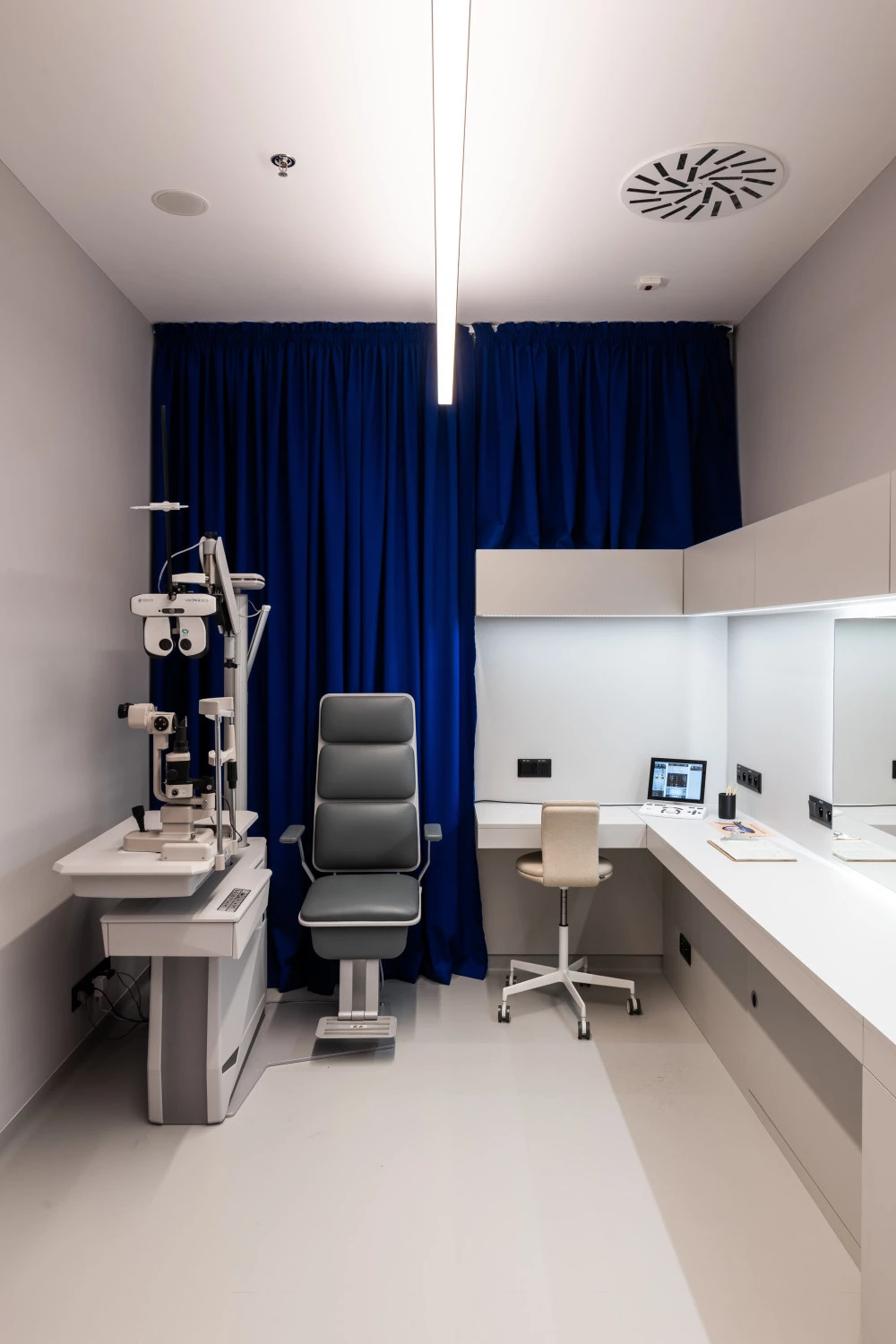
Using special instruments, we'll first look into your eyes. We'll check their refractive state and measure intraocular pressure while taking corneal thickness into account.
We'll check the clarity of your lens inside the eye, create a map of your corneal surface and verify its regularity, and also make sure your tear film is in order.
3. Visual acuity check
During the exam – which includes the old familiar reading of letters – we'll test your distance and near vision. We spend the longest time on this part, finding out everything about the quality of your vision so we can help you correct it properly.
4. Eye coordination
Besides the classic exam, we also focus on eye coordination. This is needed for precise coordination of eye movements, which is crucial for visual acuity, tracking objects, and reading.
It's also essential for orienting yourself in space and estimating distances. If your eyes don't form a perfect pair, a squint can develop. Even a very slight one can still cause excessive fatigue and possibly even double vision.
Conclusion and recommendations
Throughout the entire exam, our optometrists will explain everything clearly. And at the end, they'll also advise you on what will benefit your eyes. Whether it's eye drops or a change in correction, we're happy to help with everything.
What if you don't have any problems?
Even though it might seem like you're still seeing the same, that's not quite true. Vision changes and develops. It's influenced by our age, but also by the conditions in which we work and live. So don't forget to have your eyes checked at least once every two years.
Sometimes though, it's better to come for an exam sooner. Definitely don't delay your visit if you find yourself squinting at details and holding text or your phone farther away, you can't see clearly into the distance, especially in the evening – for example while driving, your eyes water at the end of the day or are very dry instead, or you see blurry or even double when tired.
If any of these sound familiar, book an eye exam at ZITA. We look forward to welcoming you at Pradiareň.