Multifocal or work glasses. Which ones are right for you?
25. November 2024, Author: Barbara Garaj, Photo: Nora Sapárová
Once we cross the threshold of 40, we naturally feel that our vision no longer serves us quite like it used to. Our eye lens loses elasticity, suddenly our arms seem a bit too short, and we struggle to focus at close range. We call this phenomenon presbyopia.
What's more, these days we spend more time in front of screens. So if you found yourself in the previous lines, it's possible that reading glasses alone no longer do the trick. If our optometrists confirm this is your case, they may recommend wearing multifocal glasses or work glasses. Do you know the difference between them?
Multifocal glasses
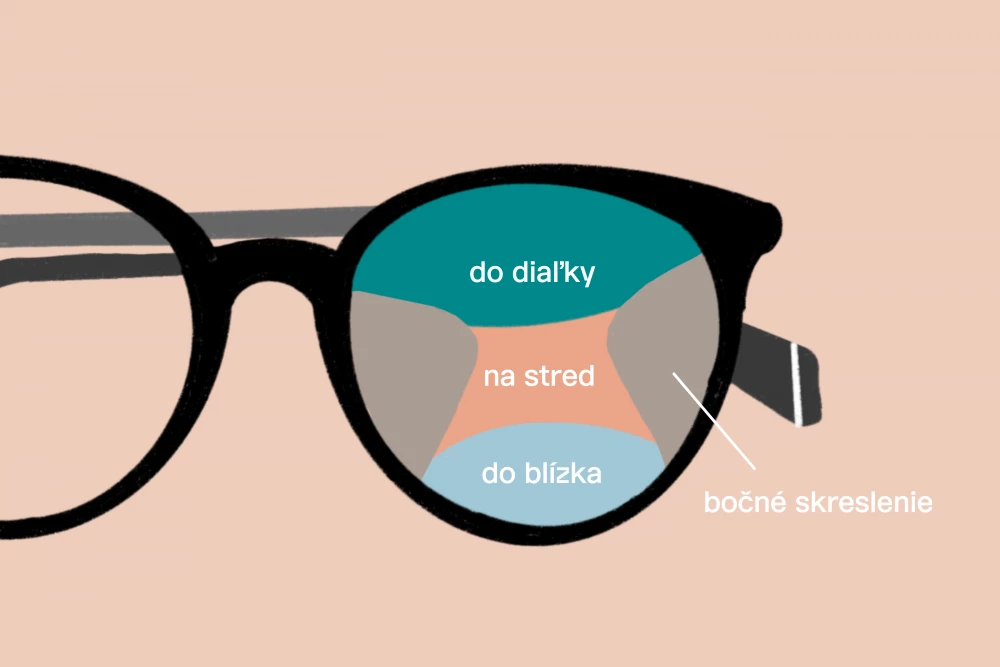
In our earlier article, we explained that multifocal lenses contain distance, intermediate, and near vision all in one lens. The transition between these prescriptions creates what's called a corridor, whose width is influenced by the near addition value and also by the type of multifocal design.
The equation is simple: the higher the quality of the lens design processing, the wider the corridor becomes and the more peripheral distortions shift to the edge zones. So when the corridor is wider, the world looks that much better to us. Keep in mind, though, that distortions can't be eliminated completely.
Why reach for multifocal glasses?
Since you find a combination of prescriptions in one pair of glasses, you don't have to switch between two pairs – one for reading and one for distance. You manage with one frame, and the gradual change in prescription lets you see all viewing distances.
So if multifocals enter your life after 40, there's no need to fear them. The important thing is to wear them regularly and get used to the gradual transition to the point where it becomes natural for you. From experience, we know the adaptation period is individual and can take roughly one to four weeks.
We also have a few tips that might help you during this process:
- for a given distance, always look through the specific part of the lens – through the top for distance, the middle for intermediate, and the bottom for near,
- when looking around a space, turn your head more than your eyes,
- we recommend first wearing them in the morning, when you and your eyes are rested,
- don't alternate between old and new glasses – you'll only prolong the adaptation process.
Multifocal glasses are universal and suitable for everyday wear. In some specific cases, though, if you spend several hours daily looking at a computer screen, you may eventually feel discomfort at intermediate distance.
This can be due to the small viewing field at intermediate range, but also whether you work with a monitor or laptop, at what height your monitor is positioned, and how far you sit from it. In that case, we'd rather recommend work glasses, which are a brilliant complement for people with multifocal glasses or reading glasses.
Work glasses
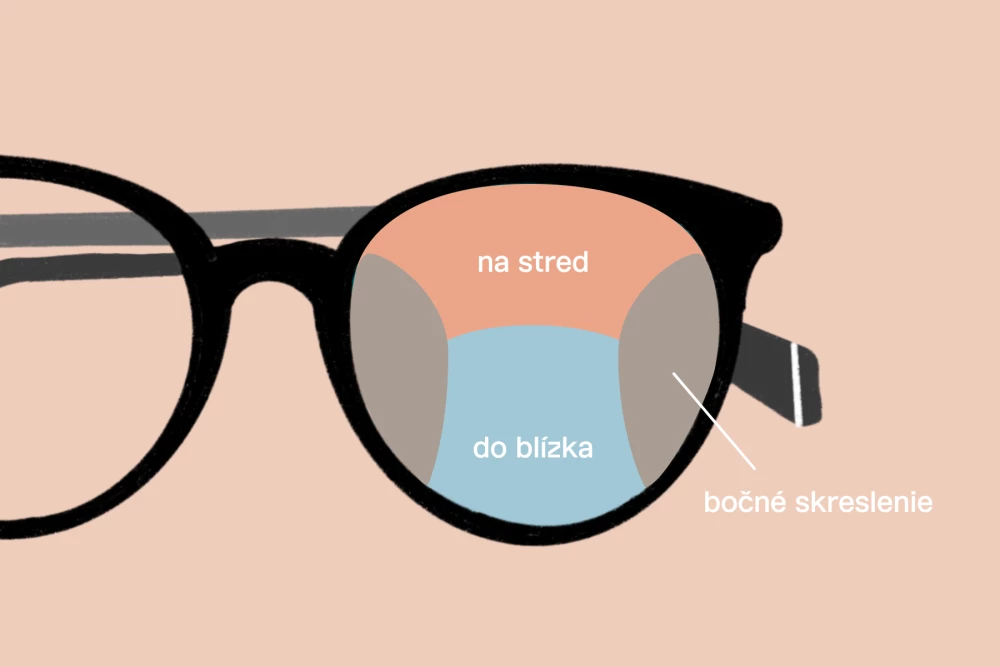
Work glasses work on a two-distance principle – an extended intermediate zone positioned in the upper part, and near vision in the lower part of the lens. You'd search for distance vision in vain. It's simply removed, which is why work glasses are ideal mainly for working with a large monitor, where you use the upper part of the lens.
Has it happened to you that with reading glasses on, you can't see the monitor well? It means there's a greater distance between you and the screen, for which reading glasses are already too strong and strain your eyes when looking.
To avoid causing ourselves unnecessary trouble in such situations, we ideally need two pairs of glasses. One for working with a monitor and another specifically for near. To avoid this switching, there's a solution in the form of work glasses.
A few rules apply when wearing work glasses too. First and foremost, they should only be used for the distances they were measured for. The upper part is adapted for the monitor and the lower part for reading. If you walk around spaces or look into the distance with work glasses on, you may feel dizzy and have an unpleasant sensation.
How do I know I need work glasses?
At a professional examination with an optometrist, we'll set the type of correction according to your needs. It's important to know how you function during the day and what your profession is. The most common candidates for work glasses are people over 50 who already wear at least reading glasses or already have multifocal glasses. That's why work glasses will never be your first pair – they serve more as a complement to the ones you already wear.
Book an examination appointment, and if you turn out to be a suitable candidate for multifocal or work glasses, our optometrists will introduce you to the right solutions.