Progressive Glasses: From Choosing the Right Lenses to Comfortable Everyday Wear
Good vision at every distance takes more than just choosing high-quality lenses.
15. october 2026, Author: Katka Grigarová, Photo: Nora Sapárová, Jakub Čaprnka
Progressive glasses can make everyday life much easier. They allow you to see clearly up close, at intermediate distances and far away without constantly switching between different pairs of glasses. Whether you're reading the morning news over coffee, driving, working at a computer, going for a walk or choosing something from a restaurant menu in the evening, one pair of glasses can do it all.
Still, progressive glasses come with plenty of questions and doubts. Why do some people get used to them in just a few days while others put them away in a drawer? At ZITA, we hear questions like these quite often. So let's take a closer look at what makes a difference when it comes to being happy with your progressive glasses.
Glasses That Keep Up With Your Day
Our near vision typically starts to change around the age of 40, at a time when we're busy working, exercising, travelling and managing all sorts of everyday responsibilities.
Reading glasses are a practical solution at this stage, but they only help with one distance. One moment they're in their case, the next you've left them on a table or you're searching for them in your bag. Over time, you might need another pair for distance vision or computer work, and constantly switching between them becomes inconvenient. With progressive glasses, one pair can take you through the entire day.
When we filmed a video with Martin, he admitted that he wasn't quite ready to join the people who regularly reach for their reading glasses. In the end, Martin left ZITA with his first pair of progressives. And as he put it himself, they were a game changer.
But What About My Neighbour Who Couldn't Get Used to Them?
We hear this question at ZITA quite often. But having a disappointing experience with progressive glasses doesn't necessarily mean they're not the right solution.
Getting progressive glasses right comes down to five things working together: lens quality, precise measurements, a properly adjusted frame, a clear explanation of how to use them and enough time to adapt. If just one of these is missing, you may end up feeling that progressive glasses simply don't work.

More Affordable vs. Higher-Quality Progressive Lenses: The Narrow Road and the Wide Road
Both a narrow road and a wide road will get you to your destination. On the narrower one, however, you need to pay more attention to staying on course and slow down at every bend. On the wider road, the journey feels more relaxed. The difference is comfort.
Progressive lenses work in a similar way. Every lens has areas for distance, intermediate and near vision. But there are many different designs, and they vary in how wide these areas are, where peripheral distortion occurs and how naturally you can see through them. We've summarised the main differences in the table below.
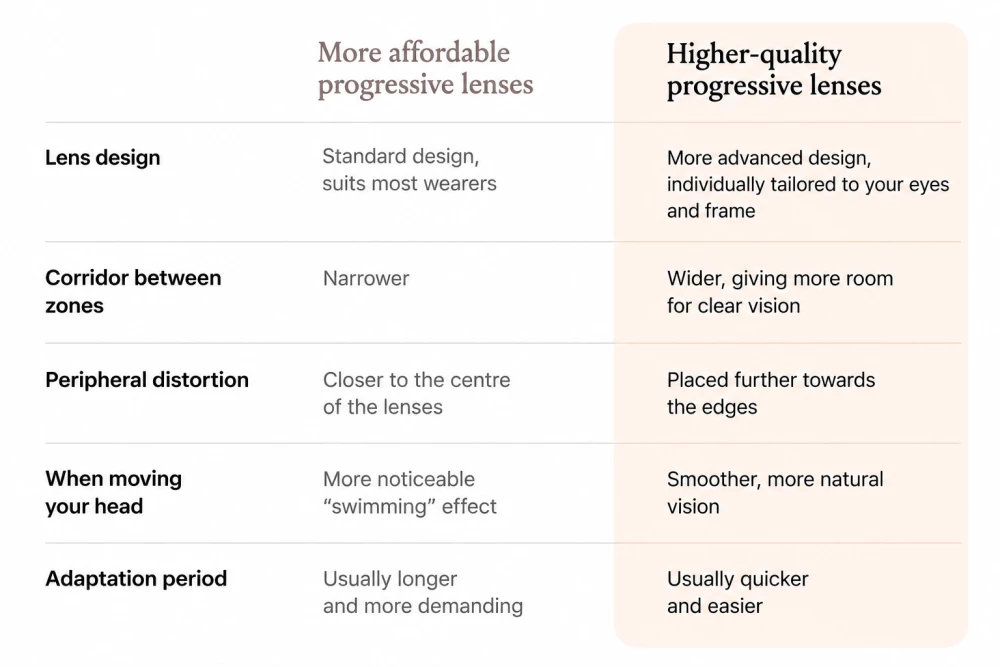
Individually optimised lenses take into account not only your prescription, but also how the frame sits on your face and the angle at which you look through the lenses.
One thing, however, applies to all progressive lenses: peripheral distortion cannot be completely eliminated, even with the most expensive options. So the difference isn't just about price, but mainly about how much the lenses can be personalised and how comfortable they are to wear.
Lens Centration: When Millimetres Matter
Lens centration means precisely determining where your pupils sit within the frame you'll actually be wearing. We measure the distance from each pupil to the centre of your nose separately, because your right and left eyes aren't necessarily the same distance from it. We also measure the height of your pupils within the frame.
For individually optimised lenses, we take additional measurements, including the frame's tilt, curvature and the distance between the lenses and your eyes.
Why is this so important? The corridor connecting the distance and near-vision zones is narrow, and millimetres make a difference. If a lens is positioned even slightly incorrectly, your eye won't be looking through the right area. You might notice it in small but unpleasant ways:
- You need to tilt your head back or lift your chin unnaturally when reading.
- One eye sees clearly while the other sees a blurred image.
- Your vision seems to sway more when walking, and you may feel dizzy.
- You lose that natural feeling of your vision falling into place.
Why You Shouldn't Buy Progressive Glasses Online
Choosing frames online sounds convenient. But with progressive glasses, there's one important problem: there's no one to take the precise centration measurements. A prescription from your eye doctor includes your prescription values, not the measurements needed to position the lenses in your chosen frame. A smartphone photo or a number from a chart can't replace professional measurements.
At ZITA, we make sure your lenses are precisely centred according to how your chosen frame actually sits on your face.
Your finished glasses also need to be adjusted, and that's simply not something you can do remotely. What seems like a cheaper purchase can easily turn into an expensive disappointment and leave you thinking that progressive glasses don't work.

How Should Your Frame Fit?
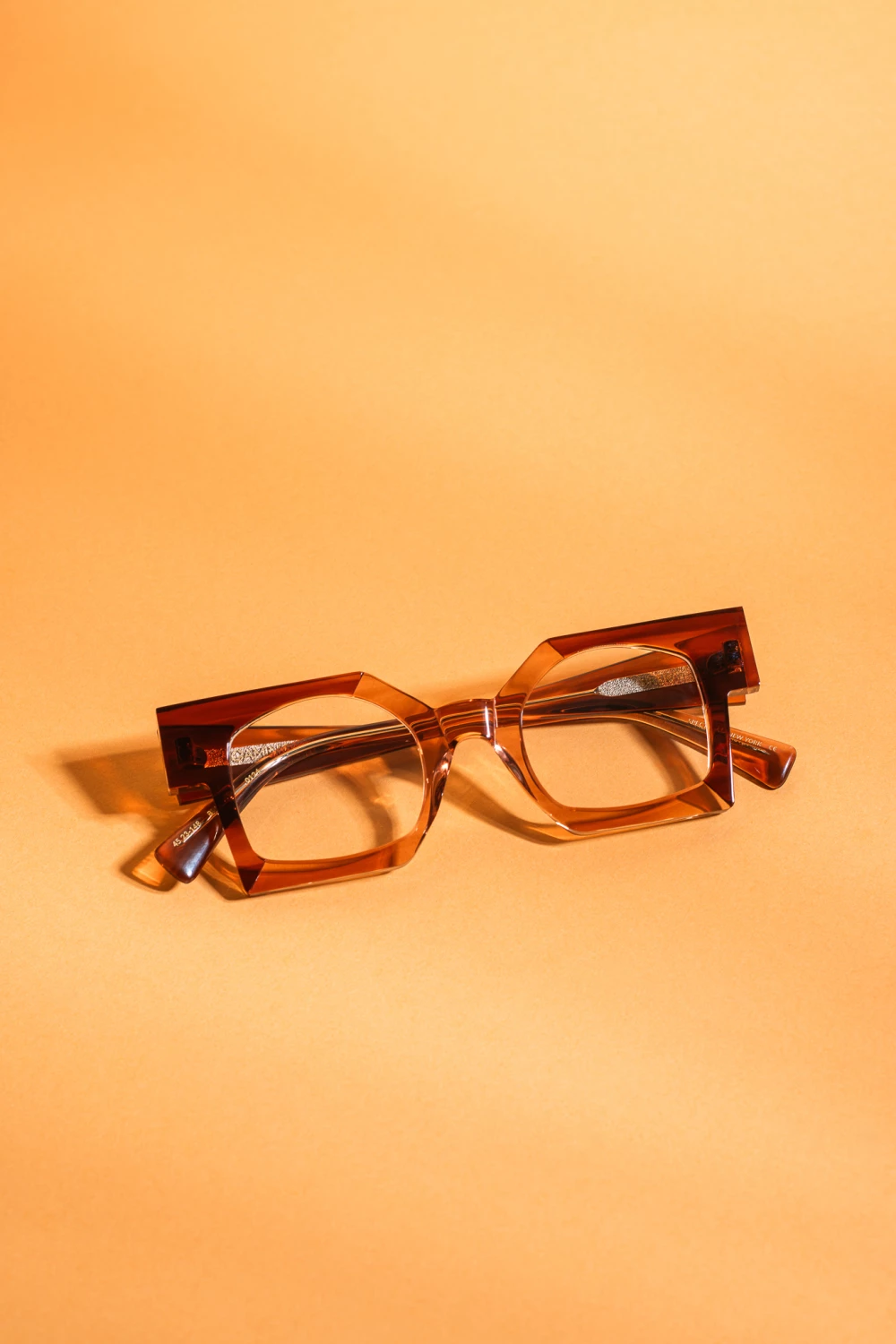
Even the best lenses need a frame that keeps them in the right position. With progressive glasses, this matters even more because every part of the lens has a specific purpose.
A properly adjusted frame should:
- Sit level, so both eyes look through the corresponding areas of the lenses.
- Stay in place on your nose, so you don't end up looking through the intermediate zone when reading and having to lift your chin.
- Keep the lenses close to your eyes without touching your eyelashes. The further away the lenses sit, the narrower the clear-vision zones can appear.
- Have the lower edge tilted slightly towards your cheeks.
- Fit securely behind your ears without putting pressure on them.
- Have enough lens height to accommodate the near-vision zone.
Frames naturally loosen with wear. If your glasses no longer fit quite as well as they did at the beginning, feel free to stop by ZITA. Adjusting them takes just a few minutes, and the difference is often immediate.
Understanding Your Glasses and Giving Yourself Time
Progressive glasses work differently from glasses designed for just one distance, so it's important to learn how to use them properly.
When you collect your glasses at ZITA, we take the time to show you how to look through them. Use the upper part of the lenses for distance vision, the middle for intermediate distances and the lower part for near vision. And when looking to the side, try turning your head rather than moving just your eyes.
From our experience, getting used to progressive glasses usually takes around one to four weeks. A few things can help:
- Put on your new glasses for the first time in the morning, when you're well rested.
- Start wearing them at home, where you feel comfortable, before heading outside or getting behind the wheel.
- Put your old glasses away in a drawer rather than constantly switching between your old and new pairs.
30 Days to Try Them
We know that progressive glasses are a significant investment. And it's natural to want to feel confident that they'll work for you before buying them.
That's why we have a simple rule at ZITA. If you can't get used to your progressive lenses within 30 days of collecting your glasses, we'll exchange them for separate lenses for distance and near vision. That way, you won't be left with glasses that you don't feel comfortable looking through.


With progressive glasses, every detail matters, from choosing the right lenses to making sure they're properly adjusted. Book an appointment at ZITA and we'll be happy to take the time to guide you through the whole process.